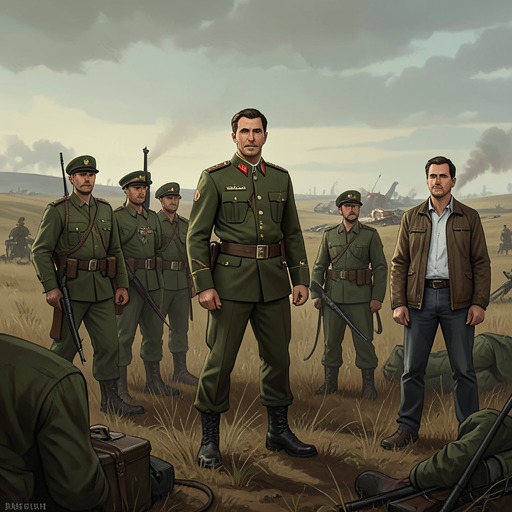
Nouaessel-sur-Rallies
Journey to the End of the NightNoirceursur-la-Lys is the destination of Ferdinand Bardamu’s wartime reconnaissance mission and the setting of a revealing encounter between soldiers’ fear and civic appeals to duty. Sent to learn whether the Germans have arrived, Bardamu reaches a town whose darkness, lights, and guarded public interests offer no clear answer; its mayor presses him and Robinson to leave so that the expected occupation can proceed as arranged. The episode makes the town less a site of military certainty than a place where survival, public responsibility, and self-interest compete.
Setting and Mission
Captain Ortolan assigns Bardamu to ride before dawn to Noirceursur-la-Lys, described as a city of weavers about ten miles from the village where the soldiers are camped. Patrol reports have contradicted one another, and General des Entrayes wants firsthand information about whether the enemy is there. Bardamu is allowed to choose one of the platoon’s less sickly horses. The mission gives him a temporary sense of setting out on a journey, but that feeling of release is illusory: he is exhausted, conspicuous, and unable to imagine clearly what may happen to him.
The town first appears not as a confirmed military position but as an uncertain landscape. Bardamu notices a veiled light above a doorway and approaches it, abandoning the intended reconnaissance long enough to knock and call to the people inside. The door opens only a crack, and a voice asks who he is. He identifies himself as a dragoon. This brief exchange makes the encounter with the town’s inhabitants a matter of immediate personal survival before it becomes a question of military intelligence.
The Town at Night
After leaving the people at the doorway, Bardamu and Robinson continue through the darkness. Noirceursur-la-Lys remains an object of speculation: the two men estimate their chances by looking toward its distant expanse of light, as if consulting cards. They still have to cross the railway, where sentries might see them, and they do not know whether an overpass or a tunnel will offer a way through. The town’s approach is therefore structured by alternatives whose consequences cannot yet be known.
Around two in the morning, Bardamu reaches a small hill and sees rows of illuminated gas jets, a brightly lit station with railcars and a buffet, and streets and neighborhoods set out in parallel lines. From his vantage point the city is entirely silent. Its light seems to lie within a surrounding darkness, but it does not tell him whether the Germans have occupied it. Bardamu reasons that German troops would usually set a place on fire after entering; because the town is still standing, he considers the possibility that they have another plan. Illumination supplies an image to read, not reliable knowledge.
Occupation Arrangements and the Mayor
In daylight, Bardamu and Robinson move through streets that make them appear harmless, as though they were returning from leave. Their conversation recalls a report about the 1st Hussars, captured in Lille after entering the city without recognizing that Germans had surrounded them. The account makes the danger of a seemingly ordinary approach explicit: a town can look open until its occupants discover that they have walked into a trap.
At a house with its lights on upstairs and down, a bearded, thickset man identifies himself as the mayor and says he is expecting the Germans. He had anticipated their arrival that night and settled arrangements with the Prefecture, including the location of their colonel and field hospital. Bardamu and Robinson are not Germans, and their unexpected presence disrupts those preparations. The mayor does not state every concern directly, but his embarrassment and the men’s reading of his situation make the practical conflict apparent: their presence could cause trouble when the expected troops arrive.
The mayor argues for the public interest and the town’s artistic heritage, especially its fifteenth-century church, which he fears might be burned as another church has been in Condé-sur-Yser. His wife and two daughters support him while he speaks. He presents the soldiers’ departure as a responsibility toward the community, not simply as a convenience for the occupation arrangements. Yet the appeal also serves the immediate purpose of clearing the town of French soldiers before the Germans arrive.
Survival Against Public Duty
The mayor’s appeal casts Bardamu and Robinson as reckless young men whose presence could endanger the town and its heritage. He does not use force as Major Pinçon would, but he is just as determined to get them to leave. In the silence, he invokes public, material, artistic, patriotic, and ethical interests; Bardamu sees these arguments as taking shape because there is no one in Noirceursur-la-Lys that night to challenge them. Their moral force is undone, in his account, by the soldiers’ fear and self-interest—and by what he calls the plain truth of their wish not to die or be burned alive.
Bardamu and Robinson cannot comfortably make that wish their public answer in wartime. Their desire to survive seems contemptible beside the language of duty, yet the scene shows that the language of collective responsibility does not remove the danger borne by the individual. They leave the mayor and wander into other deserted streets. For Bardamu, the encounter has exposed the people he has met that night: the town is not merely a point on a military map but a place where private fear and public justification come into the open.
Narrative Significance
Noirceursur-la-Lys brings together the war narrative’s uncertainty about military information and its suspicion of noble-sounding obligations. Bardamu is sent to discover whether the Germans are present, but the town’s lit station and streets cannot answer him; the mayor’s confident arrangements disclose instead how thoroughly occupation has entered local planning. Information remains incomplete, while the demand that the soldiers act is immediate.
The mayor’s concern for the church is not dismissed as wholly false: he invokes a concrete risk to a specific historic building. But the same appeal also presses Bardamu and Robinson to bear the danger of leaving, just as their own wish for safety conflicts with the town’s interests. By placing these arguments inside an encounter shaped by uncertain occupation, the episode shows how war makes duty inseparable from risk—and how civic ideals can become instruments for negotiating who must face it.